Parque Bicentenario, San Salvador5 min read
Parque Bicentenario: 91 hectares of forest inside the capital
A protected reserve straddling San Salvador and Antiguo Cuscatlán, turned into the biggest city park in Central America.
- Best time to go
- Early morning or late afternoon, when the aerobics and cycling classes run and the heat has let up. Open 6am–6pm daily.
- Getting there
- Sits right off Avenida Jerusalén, with a second access at the end of Calle La Mascota — a few minutes from Zona Rosa by car.
- Cost
- Free to walk in. Parking is $1 on weekdays, $2 on weekends. Bike rental runs from $1.50 for 30 minutes.
- How long
- 1–3 hours, longer if you bring a bike
Don't miss
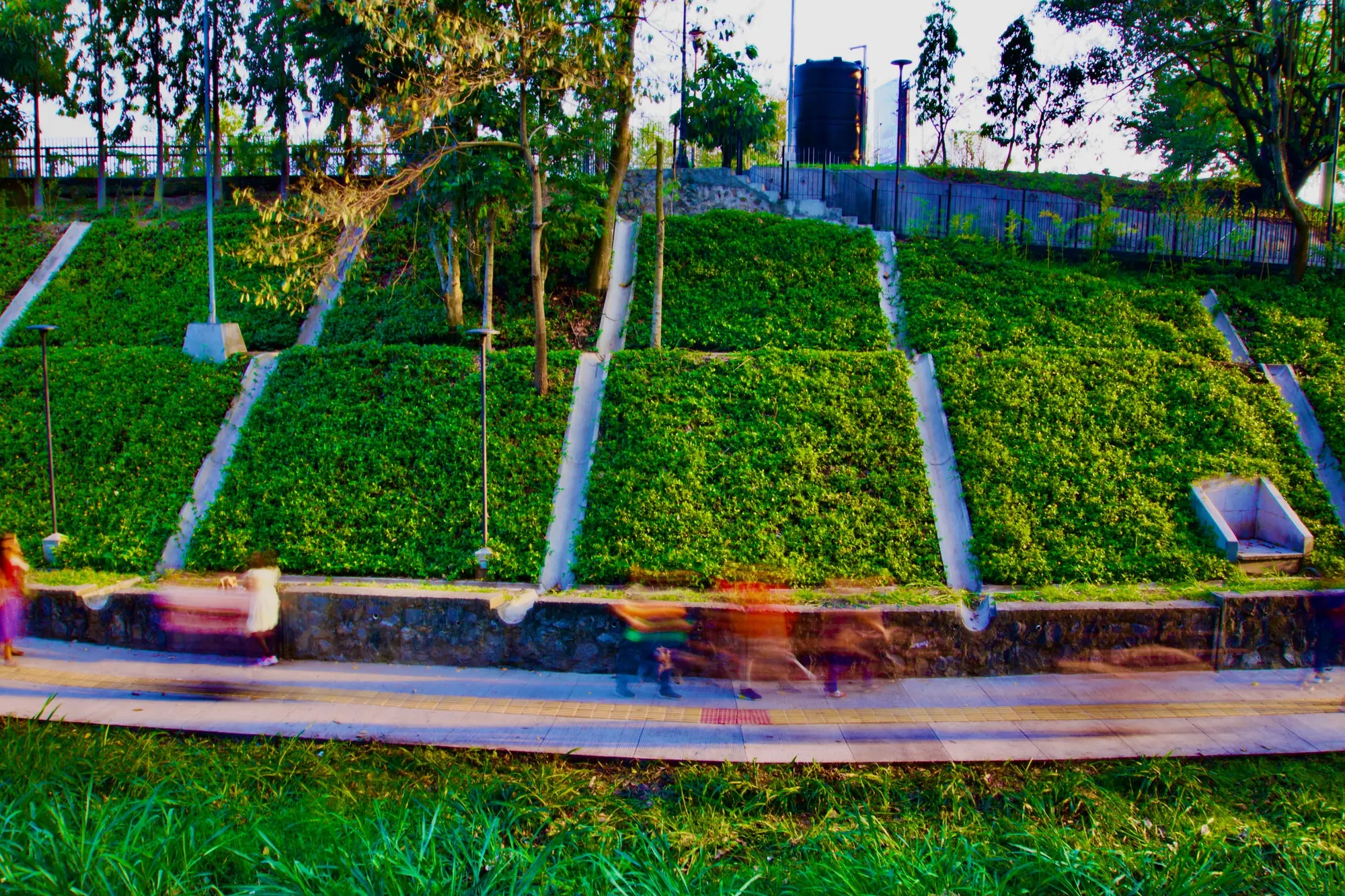
- The terraced green amphitheatre — grass steps cut by concrete drainage channels
- 3.6 km of mountain-bike trail plus the separate Sendero de las Orquídeas
- A wetland boardwalk leading to Restaurante Mestizo in the northeast corner
- Two artificial lagoons and close to 4,000 trees, over 1,300 of them native species
Parque Bicentenario sits on the old Reserva Forestal El Espino, straddling the line between San Salvador and Antiguo Cuscatlán, and at 91 hectares it is the largest ecological park inside any Central American capital. It opened on 5 November 2011, timed to the bicentennial of the region's first independence movement — hence the name.
What makes it worth a visit isn't scale on its own. It's that a protected forest this size sits a few minutes from Zona Rosa, reachable off Avenida Jerusalén without leaving the city.
The terraced amphitheatre
The most photographed corner of the park is a set of grass-covered steps, cut into trapezoids by bare concrete drainage channels running straight down the slope. It reads as landscaping rather than performance space, but it doubles as one — informal seating on a hillside that stays green year-round because the channels keep it from washing out in the rainy season. Kids use it as a running track; everyone else uses it as a photo backdrop.
Into the wetland
Past the open lawns, the park thins into denser cover — tall grass, banana plants, a fenced black boardwalk raised above ground that keeps feet dry through the wetter sections. Follow it and it comes out at Restaurante Mestizo, a dark timber pavilion in the park's northeast corner, open-sided over the water. The walk there is the better part of the destination; the restaurant is a reasonable place to end it.
What there is to do
The park is built for repeat visits rather than one big loop. 3.6 km of mountain-bike trail covers the rougher terrain, and the separate Sendero de las Orquídeas is slower going — a guided walk through the orchid collection rather than a workout. Bikes can be rented on site from $1.50 for half an hour. Free aerobics, dance, HIIT and yoga classes run through the week, along with occasional live music, so early morning and late afternoon are when the park is most active rather than emptiest.
Two artificial lagoons sit within the grounds, and the tree count is the real headline: close to 4,000 trees, more than 1,300 of them native species, planted specifically to rebuild habitat on land that had been cleared for other uses.
Practical
Entry is free. Parking costs $1 on weekdays and $2 on weekends. Hours are 6am to 6pm, every day. There's shade throughout, which is not something every park in the metro area can offer, and paths are stroller- and wheelchair-friendly on the main circuits even where the bike trail gets rougher.
Find it
Parque Bicentenario · San Salvador · San Salvador, El Salvador
- Coordinates
13.6943, -89.2509- Elevation
- 700 m
- Nature
- City